Execution of Thomas More
Wolf HallThe Execution of Thomas More is presented through the recollections of Thomas Cromwell after More’s death, rather than as an uninterrupted account of the execution itself. Its significance lies in the way a public sentence continues privately: Cromwell remembers the trial and the scaffold, handles More’s prayer book and burial arrangements, and confronts the difficulty of knowing what the dead said and meant. The event is both the outcome of a political prosecution and a lasting problem of conscience, witness, and historical memory.
From trial to execution
Five days after More’s trial, Cromwell walks in the garden with Rafe Sadler and Richard Williams. The three revisit details of the proceedings: More’s composure, the testimony of Richard Riche, and the jury’s response. More had denied saying the words attributed to him, while also arguing that even if he had spoken them, he had not meant them maliciously. Cromwell remembers the jury’s distrust of the performance and its demand for a plain answer. In retrospect, the trial’s exchanges remain unsettled in his mind: the legal argument, the question of what was said, and the question of what the words meant cannot be neatly separated.
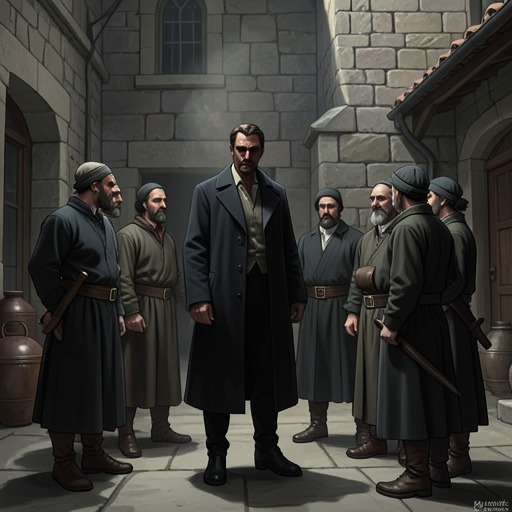
The execution is not narrated as a complete scene in the immediate aftermath. Instead, Cromwell’s memory returns to the scaffold while he works at his desk. He recalls More in a rough grey cape, identified as belonging to his servant John Wood, speaking to the headsman before removing it and kneeling to pray. Among the witnesses, Cromwell swirls his own cloak around himself and kneels. At the sound of the axe, he looks up briefly and makes the sign of the cross. The recollection supplies the essential sequence—More’s final prayer, the execution, and Cromwell’s response—without turning the death into a spectacle.
Law, conscience, and political authority
The trial’s central conflict persists in Cromwell’s recollection of More’s final argument. More insisted that he followed his conscience and that the statute under which he was condemned was faulty; he invoked the wider authority of Christendom, the saints, and the general councils of the Church against the king’s parliament and bishops. Norfolk interrupted and challenged him, and the proceedings ended with More being taken away. In Cromwell’s account, More’s resistance is not simply silence: his words continue to press against the state’s attempt to define the meaning of his conduct.
The novel sets this remembered defiance against the government’s treatment of other religious dissenters. Thomas More had been associated with the interrogation and torture of suspected heretics, and the narrative describes his use of coercive methods to obtain information about the circulation of William Tyndale’s writings. The contrast complicates any simple division between persecutor and martyr: More had exercised state and religious authority against others, while his own trial turns on the authority of the king and the limits of obedience. The execution thus belongs to a broader history of legal force used to secure testimony, impose conformity, and make political authority visible.
The dead, the living, and the record
After More’s death, Cromwell continues with ordinary business: letters concerning a vacant post, river weirs and fish traps, Lord Lisle’s account, and reports from abroad. The juxtaposition does not end the memory; More remains present in Cromwell’s thoughts while the work proceeds. Cromwell imagines that the dead persist in the minds of the living, and reflects on how the living can reshape the dead by editing their writings and rewriting their lives. He recalls, in this connection, that More had spread the report that Thomas Bilney recanted as the fire was being lit. For Cromwell, the story shows that a person’s death, like a person’s life, can become an object of contest.
More’s prayer book makes that contest tangible. Rafe Sadler brings it to Cromwell, who finds More’s name and an underlined plea, “Remember not the sins of my youth.” Cromwell first considers whether it should be sent to Alice More, then decides it should go to Margaret Roper, More’s daughter. He also arranges for Richard Williams to meet Margaret at London Bridge so she can ask for her father’s head to bury, directing that she be allowed to take it without obstruction. The book and the burial request are distinct forms of care: one preserves More’s own devotional words, while the other gives his family a chance to recover and bury his remains.
Memory and aftermath
The execution is recalled again as Cromwell later witnesses it in memory: More, accompanied to the scaffold by Humphrey Monmouth, kneels at the block, and Cromwell kneels with the other onlookers before the fatal stroke. This return to the scene connects the public event with the private burden of witnessing it. The past, as Cromwell experiences it, does not remain fixed; it moves within the present and competes with the demands of government, household, and correspondence.
The aftermath is therefore not closure. More’s prayer book, his daughter’s effort to secure his head, the disputed account of Thomas Bilney’s death, and Cromwell’s recurring recollection all show how political punishment extends beyond the condemned person. The execution ends More’s life, but it leaves unresolved questions about conscience, the authority of law, the reliability of witnesses, and who has the power to shape the dead person’s story.